We're changing how the world talks about abuse.
The Right Words is the world's largest movement dedicated exclusively to changing how abuse is reported by the media, public authorities, companies, and other organisations.
We challenge the headlines that erase perpetrators, the language that shifts responsibility onto victims, and the reporting habits that have become so familiar that we barely question them anymore.
Behind every headline is a real person and behind every editorial decision is a choice about what the public will understand.
We believe those choices deserve far more scrutiny than they currently receive.
And we're doing something about it.
Language can hide the truth.
For decades, the way abuse is reported has followed many of the same patterns: perpetrators disappear from headlines and victims become the sole focus of stories about crimes committed against them.
Violence is romanticised, minimised, excused, or presented as something that happened without anyone making it happen.
Often, these are habits so deeply embedded in our language that even experienced journalists fail to recognise them. But the consequences matter.
Language influences how the public understands abuse, where it places responsibility, and how victims are perceived.
We know that changing language alone will not end abuse. But we also believe that changing how we understand and respond to abuse is considerably harder when the words we use continue to obscure what happened.
We challenge harmful reporting.
Calling out headlines that erase perpetrators or shift blame onto victims.
We support better communication.
Working with media organisations, public authorities, companies, and other institutions to improve how they communicate about abuse.
We provide practical solutions.
Sharing guidance, training, conversations, and real-world examples of more accurate reporting.
We build an international movement.
Bringing together people who believe that the way we describe abuse can, and must, change.

Andreea Groenendijk-Deveau
Founder. Social entrepreneur. Editorial leader.
The Right Words was founded by Andreea Groenendijk-Deveau, a London-based social entrepreneur and editorial leader whose work sits at the intersection of media, technology, advocacy, and social change.
Her experience spans journalism, entrepreneurship, and the development of ventures designed to address problems that established systems have struggled to solve.
She is also the Founder of Outcry Witness, a platform enabling survivors of sexual violence to create secure, anonymous records of their experiences without the pressure to report to the authorities before they are ready.
Her work on Outcry Witness brought her face to face with a recurring problem: the enormous distance between what people experience and how those experiences are described, interpreted, and understood by themselves and others.
Having spent years on the editorial side of the equation, she knew something important.
In September 2025, she launched The Right Words to do precisely that.
What began as a campaign questioning the language used in news headlines has developed into an international movement engaging tens of thousands of people and reaching millions more.
Today, Andreea works to bring the issue of language and responsibility into conversations with journalists, editors, police, public authorities, academics, and organisations working to prevent abuse and support survivors.
She is a speaker and advocate for institutional accountability, with a particular interest in the relationship between language, power, public perception, and access to justice.
Her approach combines the editorial judgement of someone who understands how newsrooms work with the determination of an entrepreneur who isn't particularly interested in accepting that things have always been done a certain way.
For Andreea, The Right Words is about challenging something much bigger than an unfortunate headline.
It's about changing what society has learned to accept.
From a campaign to international change.
The Right Words launched on 24 September 2025. In its first year, it grew into a community of tens of thousands, reaching millions of people and challenging hundreds of examples of harmful reporting.
People have joined the movement.
People reached across platforms.
Headlines challenged and rewritten.
But the ambition goes way further than simply building an audience.
We want newsrooms to rethink their editorial conventions. We want public authorities to examine the language they use in official communications. And we want organisations to understand that the words they choose can reinforce the very attitudes they are trying to challenge.
Our work includes practical editorial guidance, direct challenges to published reporting, educational initiatives, and collaboration with organisations prepared to examine their own practices.
The movement has also expanded internationally through our Romanian sister campaign, Spune Lucrurilor pe Nume, taking the same challenge to journalists and institutions in Romania.
Different countries. Different languages. Many of the same deeply entrenched habits.
Outcry Witness
The Right Words is part of a wider commitment to improving how people who have experienced abuse are heard, understood, and supported.
Founded by Andreea in 2022, Outcry Witness provides a secure, anonymous platform where survivors of sexual violence can document what happened to them in their own time.
There is no pressure to report to the police. No requirement to disclose their identity. No expectation that they must be ready to take action before they can begin creating a record.
While Outcry Witness addresses some of the practical barriers survivors face when considering disclosure or reporting, The Right Words challenges the wider language and attitudes that can make speaking about abuse so difficult in the first place.
The two initiatives are distinct, but the principle connecting them is simple.
Challenging conversations and changing minds.
The Right Words contributes to conferences, professional forums, and public discussions examining violence against women and girls, the responsibilities of institutions, and the role language plays in public understanding.
Our Founder brings together editorial leadership, entrepreneurship, and direct experience building platforms for survivors.
She challenges audiences to examine not only what they communicate, but also the assumptions they may be reinforcing without realising it.

Break Free Conference
Hosted by The Jessica Project and Project Salama in Reading, discussing practical ways to tackle violence against women and girls.

Our Safer City
Inspiring the Future: Preventing Violence Against Women and Girls and Domestic Abuse Through the Employer Lens, held at Guildhall, London.

Hertfordshire VAWG Strategy Launch
Speaker at the launch of Hertfordshire's first Violence Against Women and Girls strategy.
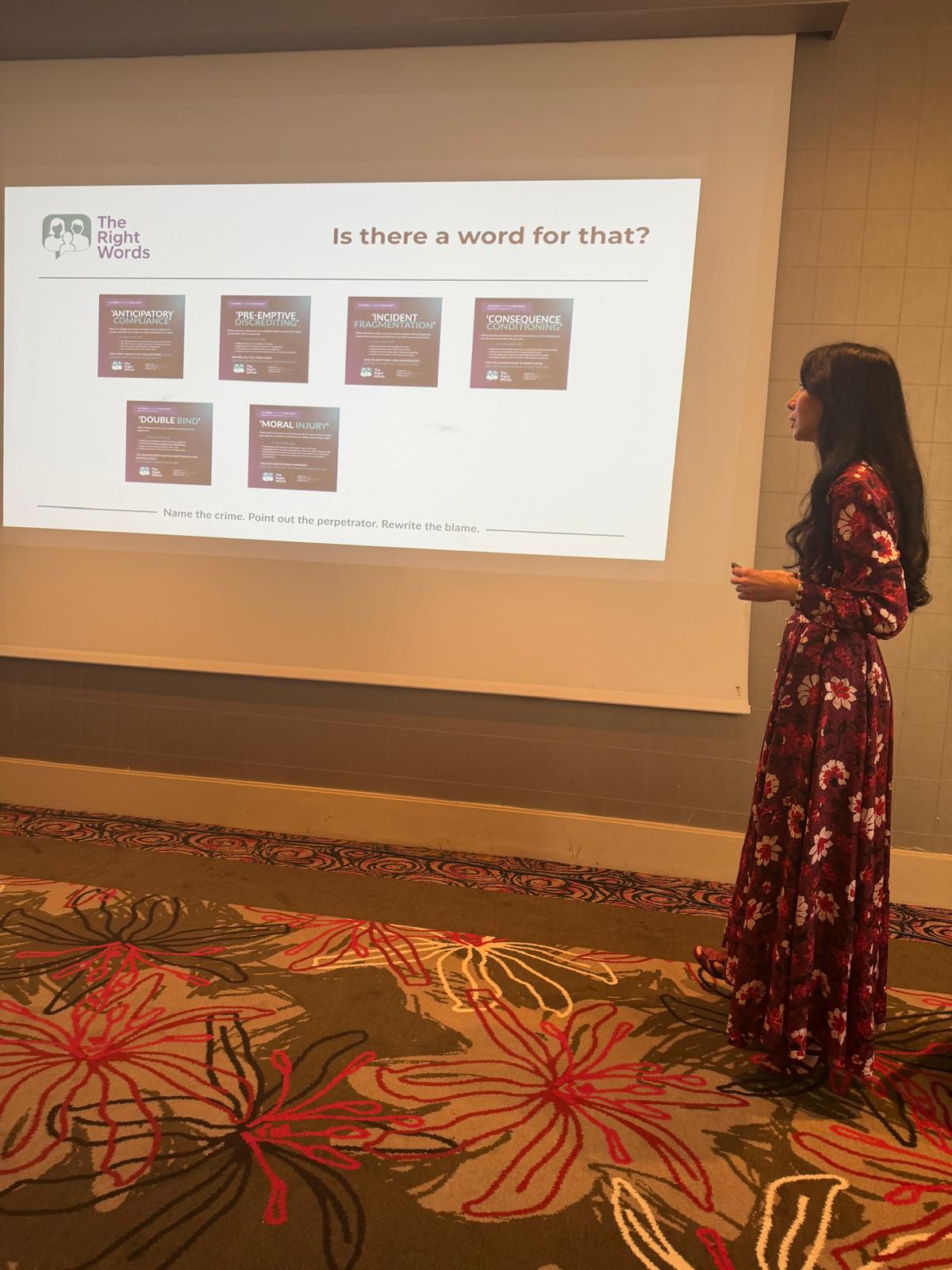
Every Little Thing Festival
Andreea presented our work and hosted a fireside conversation with a survivor and the Founder of Project Salama, exploring coercive control, its lasting impact, and the importance of having the words to describe experiences of abuse.
EIDA: The Right Words
Andreea Groenendijk-Deveau presents the work of The Right Words for the Employers' Initiative on Domestic Abuse (EIDA), examining how the language we use to describe abuse influences public understanding and accountability.
Training, speaking, and institutional change.
We work with journalists, newsrooms, police forces, public authorities, universities, charities, businesses, and professional associations.
Our work ranges from challenging individual headlines to helping organisations reconsider their approach to communicating about abuse.
Sessions can be tailored to journalists, communications teams, leadership groups, safeguarding professionals, and public bodies.
Language, Power, and Accountability
How reporting can reinforce or challenge harmful assumptions about abuse, and why language matters to public understanding.
The Invisible Perpetrator
Why responsibility so often disappears from headlines, public statements, and institutional communications.
Responsible Journalism
How editorial decisions can preserve accuracy without minimising crimes or shifting blame onto victims.
Trauma-Informed Communication
How organisations can communicate difficult experiences without introducing further unnecessary harm.
Institutional Responsibility
Why language matters in policing, safeguarding, public communications, and access to justice.
From Newsroom to Advocacy
Reflections on editorial leadership, entrepreneurship, power, and the responsibility to challenge established ways of working.
Our approach is deliberately practical. We believe journalists and institutions can improve their language without compromising factual accuracy, editorial independence, or legal safeguards.
In fact, we believe responsible reporting demands it.
Let's talk about what 'better' looks like.
We're interested in working with organisations that are prepared to examine their language seriously, particularly those whose words carry institutional authority or influence public understanding.
Whether you're a newsroom reconsidering your reporting standards, a police force reviewing its public communications, a university interested in research, or an organisation looking for a speaker who will challenge the room rather than simply agree with it, we'd like to hear from you.
The Right Words isn't asking anyone to change the facts. We're asking them to stop hiding behind the language used to describe them.