
A series by The Right Words
Is there a word for that?
Because finding the right words can change everything.
This series explores experiences of coercive control that can be difficult to recognise or describe, offering language to help make sense of what happened.
Explore the series
Finding the words.
Select a card to read the accompanying caption. The collection includes established terms alongside wording proposed by The Right Words, explained within each post.
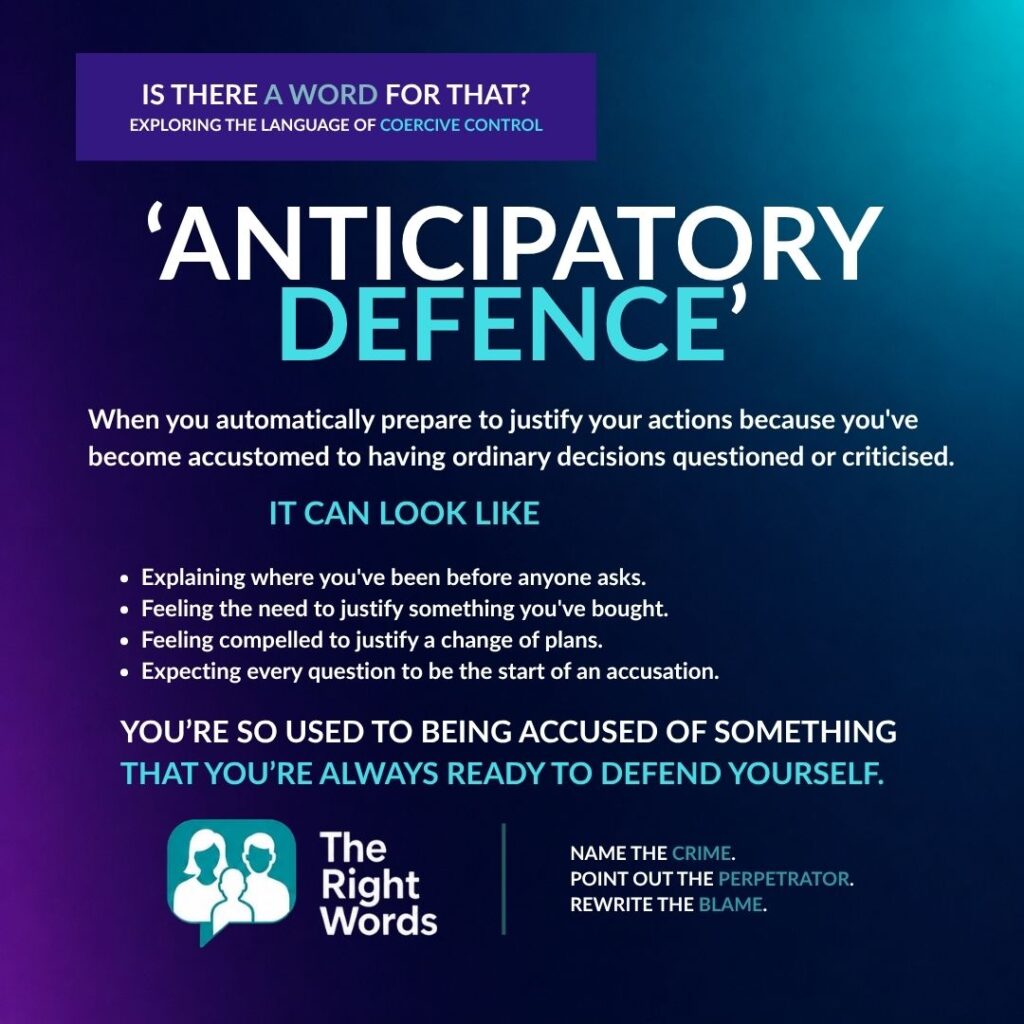
Anticipatory Defence
We're using ‘anticipatory defence’ to describe the habit of preparing explanations or justifications before they're needed, particularly after experiencing repeated criticism or questioning within…
Read more +
Read less −
Anticipatory Defence
We're using ‘anticipatory defence’ to describe the habit of preparing explanations or justifications before they're needed, particularly after experiencing repeated criticism or questioning within…
Read more + Read less −A friend asks why you took a different route home and it's an ordinary question - they might simply be curious.
But before they've even finished asking, you're rushing to explain yourself: you tell them about the traffic and why you thought it would be quicker.
And only afterwards do you realise that nobody was accusing you of anything.
We're using ‘anticipatory defence’ to describe the habit of preparing explanations or justifications before they're needed, particularly after experiencing repeated criticism or questioning within a controlling relationship.
When ordinary decisions have regularly been treated as something you must defend, you can begin expecting that reaction everywhere - even from people who have never given you a reason to expect it.
The situation has changed and you may be finally safe, but your response hasn't necessarily caught up.
Name the crime. Point out the perpetrator. Rewrite the blame.
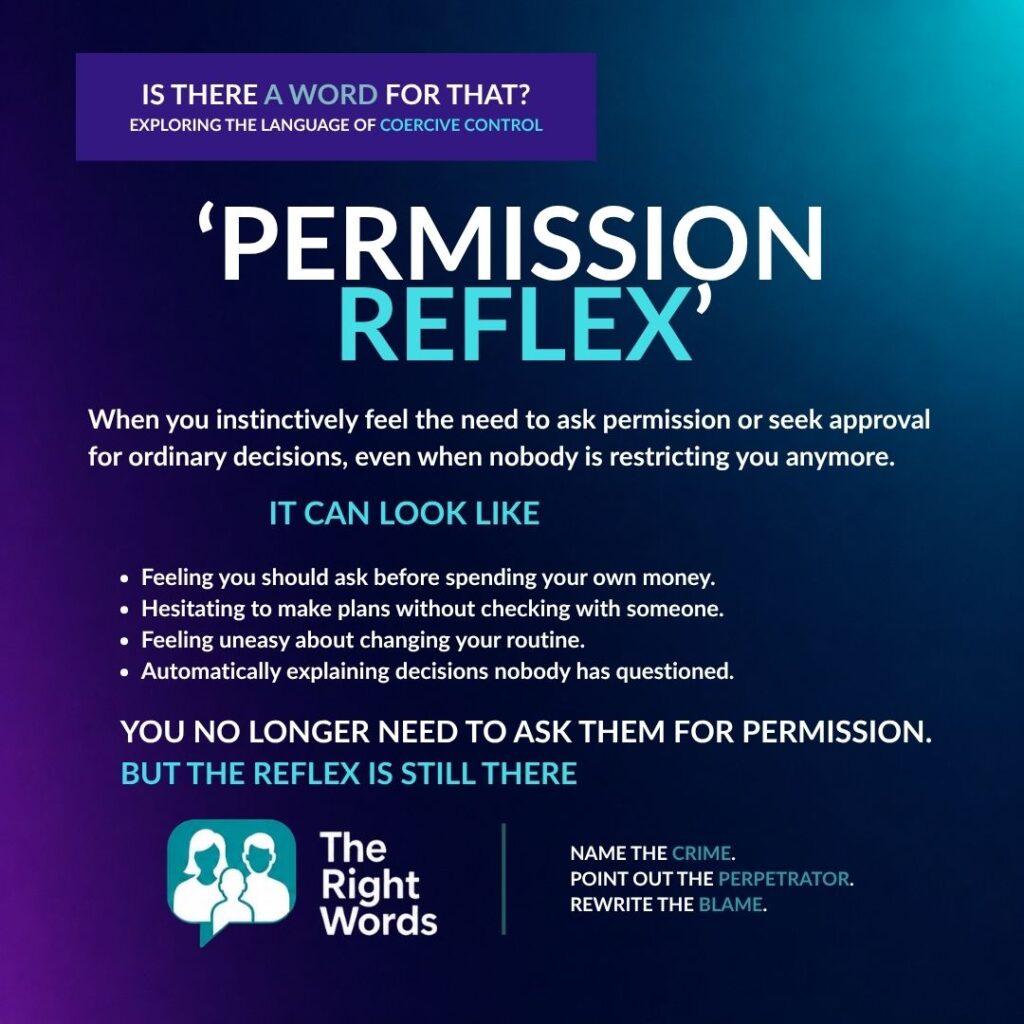
Permission Reflex
We're proposing ‘permission reflex’ to describe the instinctive need to seek approval for ordinary decisions after spending a long time in a situation where…
Read more +
Read less −
Permission Reflex
We're proposing ‘permission reflex’ to describe the instinctive need to seek approval for ordinary decisions after spending a long time in a situation where…
Read more + Read less −You want to buy something, make plans for the weekend, visit your family, or simply go somewhere without explaining where you're going. And somehow, you feel as though you should ask someone first.
Except there's nobody you need to ask.
We're proposing ‘permission reflex’ to describe the instinctive need to seek approval for ordinary decisions after spending a long time in a situation where your independence was restricted.
It isn't necessarily a conscious thought - you may catch yourself hesitating before doing something perfectly ordinary, or feel strangely uncomfortable making a decision that affects nobody else.
The person who once questioned or conditioned your choices may no longer be present, but the habits you developed around them can remain.
And recognising those habits matters. Because what looks like a lack of confidence may be something learned through repeated experiences of control.
Name the crime. Point out the perpetrator. Rewrite the blame.

Preference Erosion
We're exploring ‘preference erosion’ as a way of describing the gradual loss of connection with your own likes and wishes after prolonged control.
Read more +
Read less −
Preference Erosion
We're exploring ‘preference erosion’ as a way of describing the gradual loss of connection with your own likes and wishes after prolonged control.
Read more + Read less −“What would you like?”
Such a simple question, right... ?
But sometimes, after experiencing coercive control, the answer isn't immediately obvious.
You may have spent years accommodating someone else's preferences, to avoid their reactions. Choosing the restaurant they'd like, watching what they wanted to watch, going where they wanted to go, and changing your plans because their preferences always seemed to matter more.
Eventually, you might stop asking yourself what you actually want.
We're exploring ‘preference erosion’ as a way of describing the gradual loss of connection with your own likes and wishes after prolonged control.
And this can show up in surprisingly ordinary moments - someone asks what you'd like for dinner, and you genuinely don't know. You're free to choose, but you've become so accustomed to considering someone else's preferences first that identifying your own takes effort.
This is different from decision paralysis. Sometimes, the difficulty isn't choosing between two things you want.
It's remembering that what you want matters at all.
Name the crime. Point out the perpetrator. Rewrite the blame.
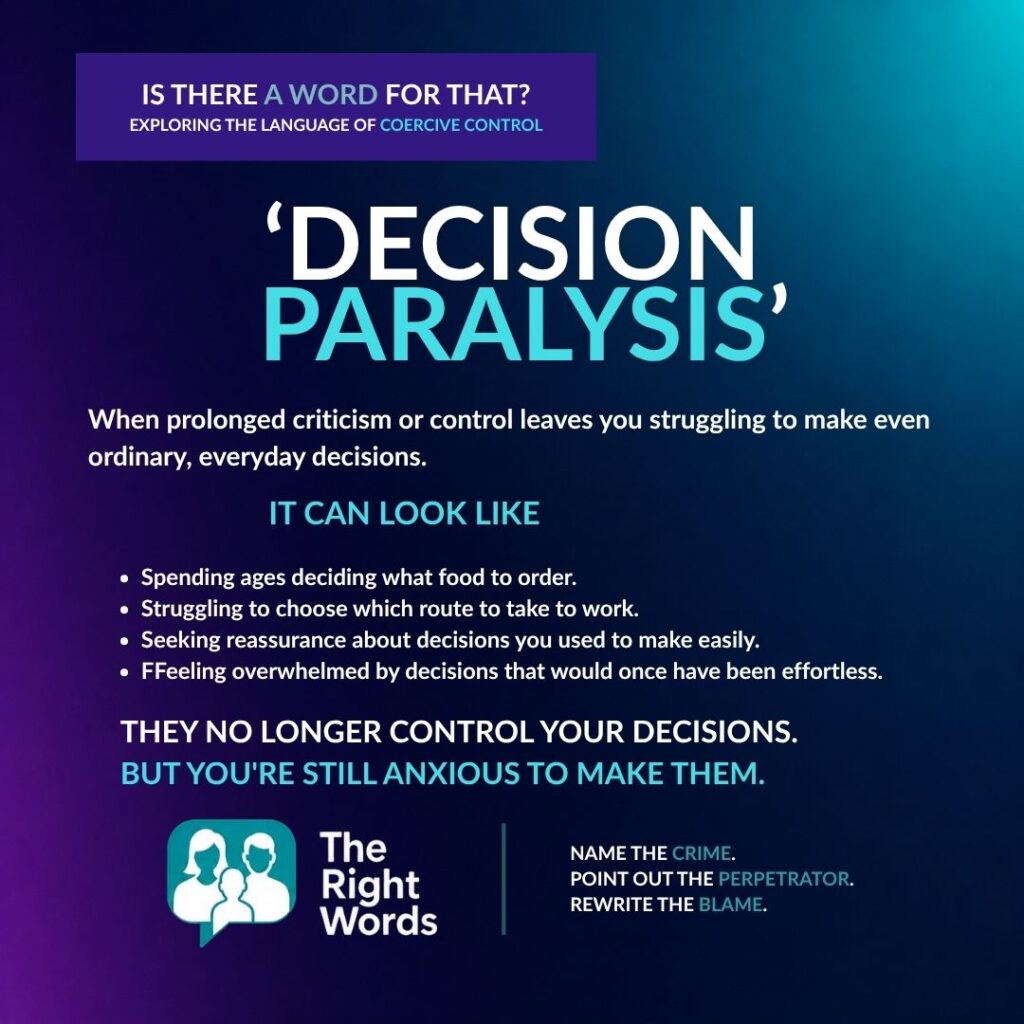
Decision Paralysis
'Decision paralysis' is an established term for difficulty making choices. In the context of coercive control, it can reflect the lasting effects of having…
Read more +
Read less −
Decision Paralysis
'Decision paralysis' is an established term for difficulty making choices. In the context of coercive control, it can reflect the lasting effects of having…
Read more + Read less −What should I order or cook for dinner? Which route should I take to work today? Should I buy this one or that one?
Ordinary decisions, things most people do without giving it much thought.
But after experiencing coercive control, even these seemingly insignificant choices can become unexpectedly difficult.
You might spend ages comparing two options, ask someone else to decide for you, or find yourself unable to choose at all.
And the strange thing is that the decision itself might have absolutely nothing to do with the person who controlled you.
'Decision paralysis' is an established term for difficulty making choices. In the context of coercive control, it can reflect the lasting effects of having your judgement repeatedly questioned or your decisions criticised. When someone has spent a long time making you doubt your ability to choose correctly, that uncertainty doesn't necessarily disappear when they're no longer around.
You can find yourself hesitating over things that carry no meaningful consequences, simply because making decisions no longer feels easy. And from the outside, it can look like ordinary indecisiveness, when there's a much more complicated history behind it.
Name the crime. Point out the perpetrator. Rewrite the blame.

Proxy Control
We’re using ‘proxy control’ to describe coercive control exercised indirectly, through people, institutions, situations, or circumstances that give someone continued access to your life.
Read more +
Read less −
Proxy Control
We’re using ‘proxy control’ to describe coercive control exercised indirectly, through people, institutions, situations, or circumstances that give someone continued access to your life.
Read more + Read less −Sometimes, creating distance from someone doesn’t end their ability to exert control.
Other people can become messengers - children can become a route for information. Shared finances or responsibilities can create opportunities for continued interference, and even formal processes can become another way of maintaining contact or applying pressure.
We’re using ‘proxy control’ to describe coercive control exercised indirectly, through people, institutions, situations, or circumstances that give someone continued access to your life.
That distinction matters because, viewed separately, each interaction may appear to come from somewhere else: a message from a relative, A dispute over money, another piece of correspondence, another reason contact is apparently necessary.
But the route may have changed while the dynamic remains.
And when someone deliberately uses those routes to continue exercising control, the fact that they are no longer contacting you directly doesn’t make their behaviour any less significant.
Name the crime. Point out the perpetrator. Rewrite the blame.

Retrospective Recognition
We're using ‘retrospective recognition’ to describe that experience: recognising the nature of what has been happening only after you've lived through much of it,…
Read more +
Read less −
Retrospective Recognition
We're using ‘retrospective recognition’ to describe that experience: recognising the nature of what has been happening only after you've lived through much of it,…
Read more + Read less −“Why didn't you realise what was happening at the time?”
Because sometimes, with coercive control, understanding comes much later.
When you're living through something, you experience it as it happens - one conversation, one reaction, one compromise, one explanation for why this time was different. And you don't necessarily understand what all those moments add up to.
But over time, things can begin to look different. Behaviours you accepted as normal take on a different meaning. Memories you once considered unrelated begin to form a pattern.
We're using ‘retrospective recognition’ to describe that experience: recognising the nature of what has been happening only after you've lived through much of it, sometimes months or years later.
This matters because people experiencing coercive control are so often judged for what they didn't recognise at the time. As though they should have understood the whole picture while they were still trying to make sense of each individual moment.
But recognising something later doesn't make that recognition any less valid.
Name the crime. Point out the perpetrator. Rewrite the blame.
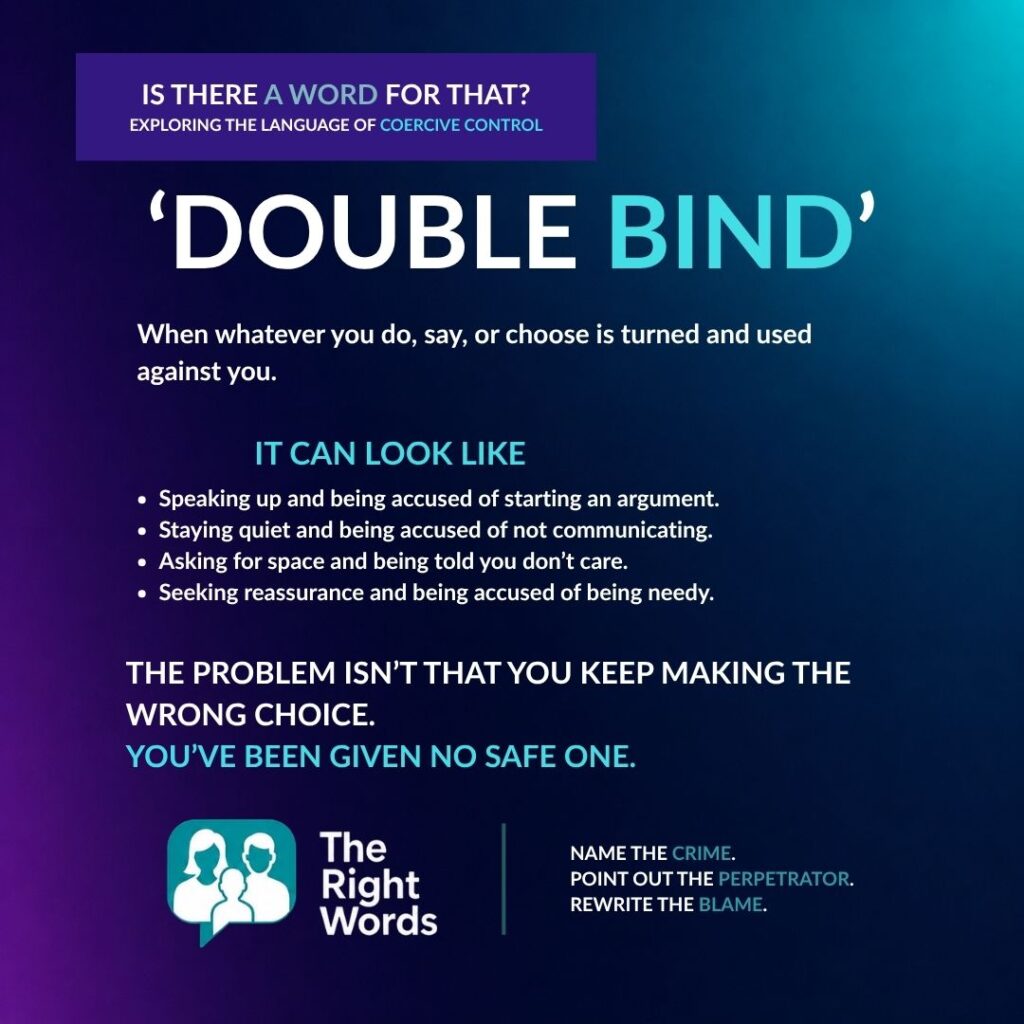
Double Bind
A double bind places someone in a no-win situation, where contradictory expectations mean that different responses can both bring negative consequences.
Read more +
Read less −
Double Bind
A double bind places someone in a no-win situation, where contradictory expectations mean that different responses can both bring negative consequences.
Read more + Read less −Have you ever felt as though whatever you do, somehow you’ve done the wrong thing?
There’s a term that can help describe this: double bind.
A double bind places someone in a no-win situation, where contradictory expectations mean that different responses can both bring negative consequences.
In coercive control, that can leave someone constantly trying to work out what the “right” response is. They may change how they behave, second-guess themselves, or become increasingly careful about what they say and do, without recognising that the problem may not be their ability to choose correctly at all.
Because sometimes there is no answer that will satisfy the other person - the rules shift with the response.
Name the crime. Point out the perpetrator. Rewrite the blame.
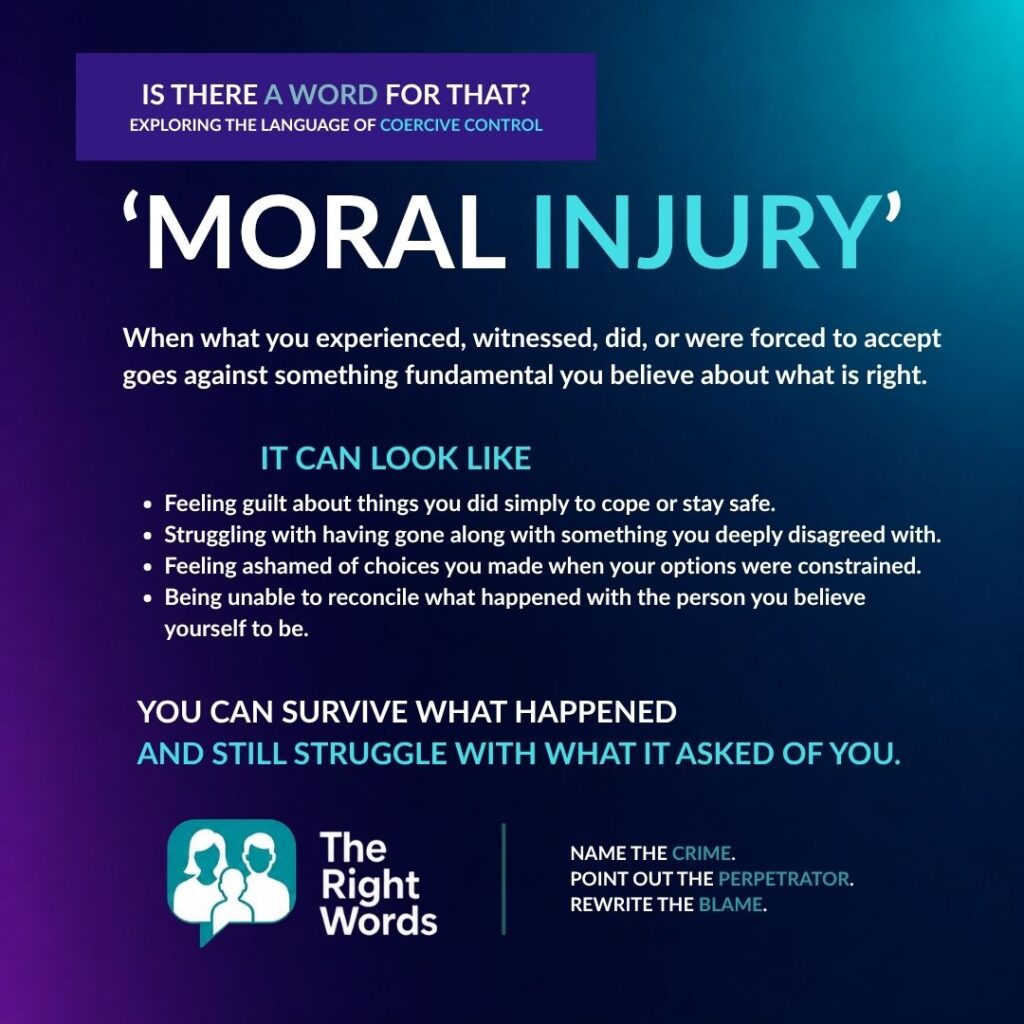
Moral Injury
Sometimes, what stays with you isn’t only what someone else did - it’s what you did, accepted, tolerated, or became while trying to get…
Read more +
Read less −
Moral Injury
Sometimes, what stays with you isn’t only what someone else did - it’s what you did, accepted, tolerated, or became while trying to get…
Read more + Read less −Sometimes, what stays with you isn’t only what someone else did - it’s what you did, accepted, tolerated, or became while trying to get through it.
Perhaps you lied to keep the peace; stayed silent when something felt deeply wrong; apologised when you had done nothing wrong; behaved in ways you don’t recognise now; went along with something because resisting it felt impossible.
Maybe you’re still asking yourself, “How could I have done that?”
There is language for this: moral injury.
It describes the lasting distress that can follow experiences which violate deeply held moral beliefs or expectations, including things we did ourselves, witnessed, failed to prevent, or experienced through betrayal.
In the context of coercive control, that distinction can matter enormously, because looking back at a decision without looking at the circumstances in which it was made can turn survival decisions into sources of shame.
Understanding the context doesn’t require pretending those decisions don’t matter. It means understanding what was being asked of you, what choices genuinely felt available at the time, and why you may still be struggling to reconcile that person with who you understand yourself to be.
Name the crime. Point out the perpetrator. Rewrite the blame.
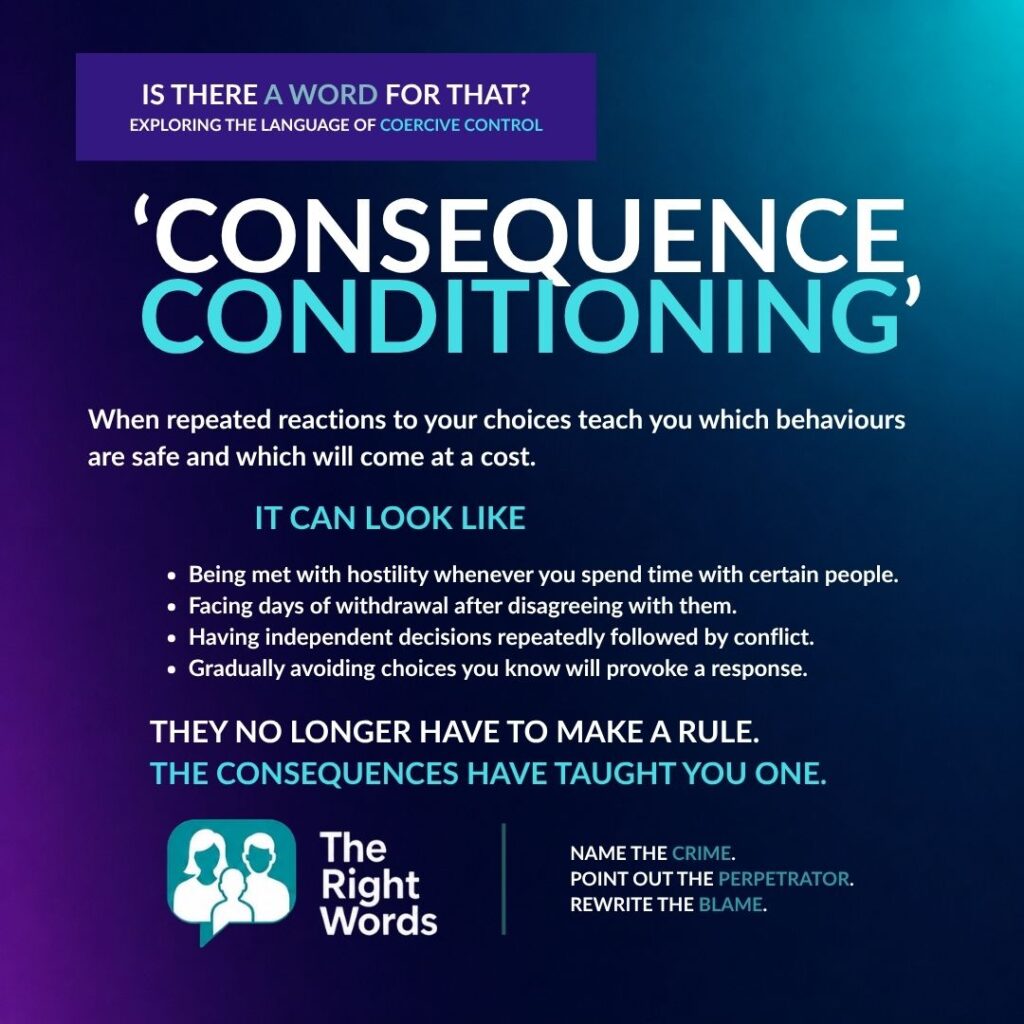
Consequence Conditioning
We’re proposing ‘consequence conditioning’ to describe when repeated reactions to your choices teach you which behaviours feel safe and which come at a cost.
Read more +
Read less −
Consequence Conditioning
We’re proposing ‘consequence conditioning’ to describe when repeated reactions to your choices teach you which behaviours feel safe and which come at a cost.
Read more + Read less −When it comes to coercive control, there doesn’t always have to be a rule. Sometimes, the consequences are enough.
You see certain friends, and there’s a reaction; you disagree, and they withdraw; you make a decision for yourself, and conflict follows. It happens often enough that eventually you begin making different choices.
We’re proposing ‘consequence conditioning’ to describe this process: when repeated reactions to your choices teach you which behaviours feel safe and which come at a cost.
Nobody necessarily has to say, 'You’re not allowed to do that,' because the message is delivered in a more subtle way.
And once you’ve learned it, the other person may no longer need to react at all, because you begin anticipating the consequences and adjusting your behaviour before they happen.
Name the crime. Point out the perpetrator. Rewrite the blame.
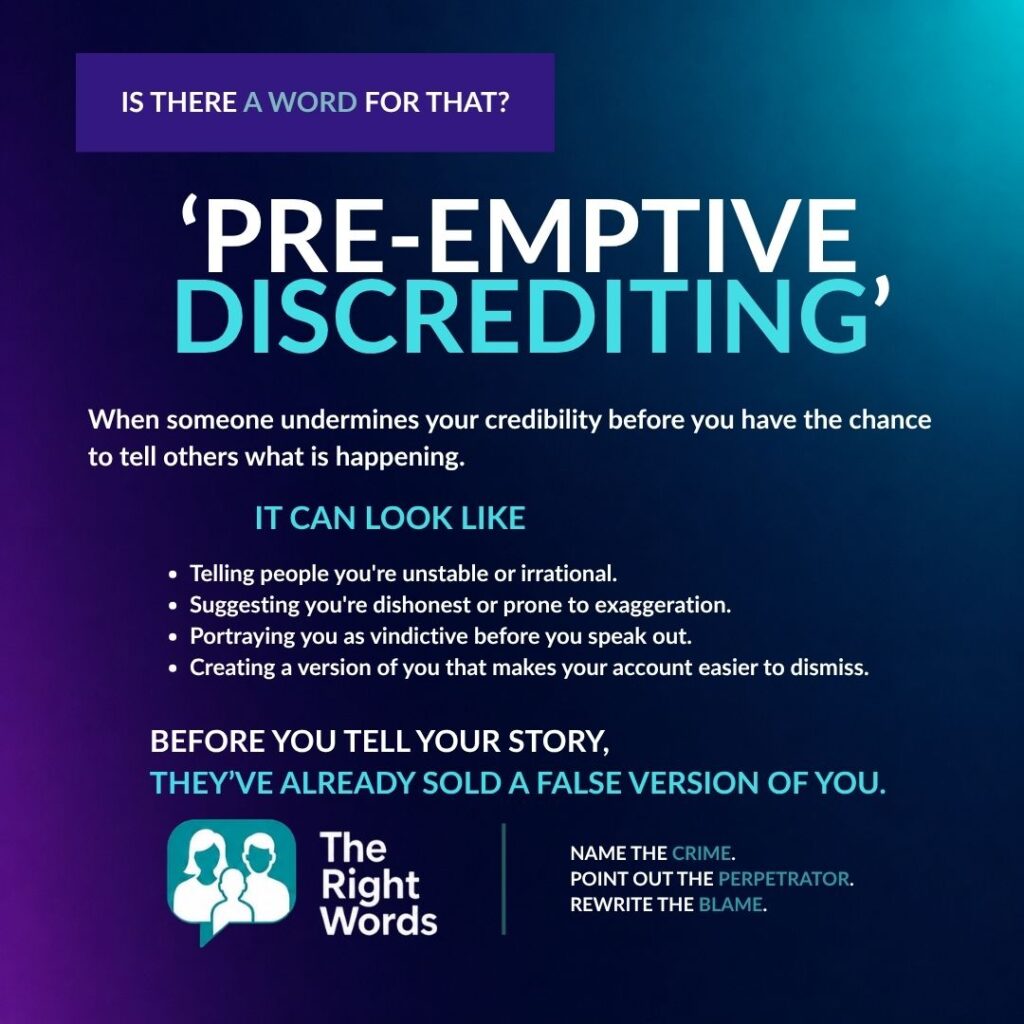
Pre-emptive Discrediting
Piece by piece, a version of that person is built for everyone else, so when they eventually try to explain what has been happening,…
Read more +
Read less −
Pre-emptive Discrediting
Piece by piece, a version of that person is built for everyone else, so when they eventually try to explain what has been happening,…
Read more + Read less −Another in our Is there a word for that? series, created to help people experiencing, or who have experienced, coercive control find language for what is happening to them.
Sometimes, discrediting someone starts before they’ve said a word.
We’ve heard it all, in some shape or form - they’re “unstable”; they exaggerate; they’re difficult; they hold grudges; and, of course, they can’t be trusted.
Piece by piece, a version of that person is built for everyone else, so when they eventually try to explain what has been happening, their credibility has already been weakened.
This has a name: pre-emptive discrediting, and it can be particularly effective because whatever happens next may be interpreted through the story that has already been established. Anger becomes proof that they’re irrational. Distress becomes proof that they’re unstable. Speaking up becomes proof that they’re vindictive.
The focus shifts away from what someone has done and towards whether the person describing it can be believed.
Before you even get to tell your story, they’ve already sold a false version of you.
Name the crime. Point out the perpetrator. Rewrite the blame.
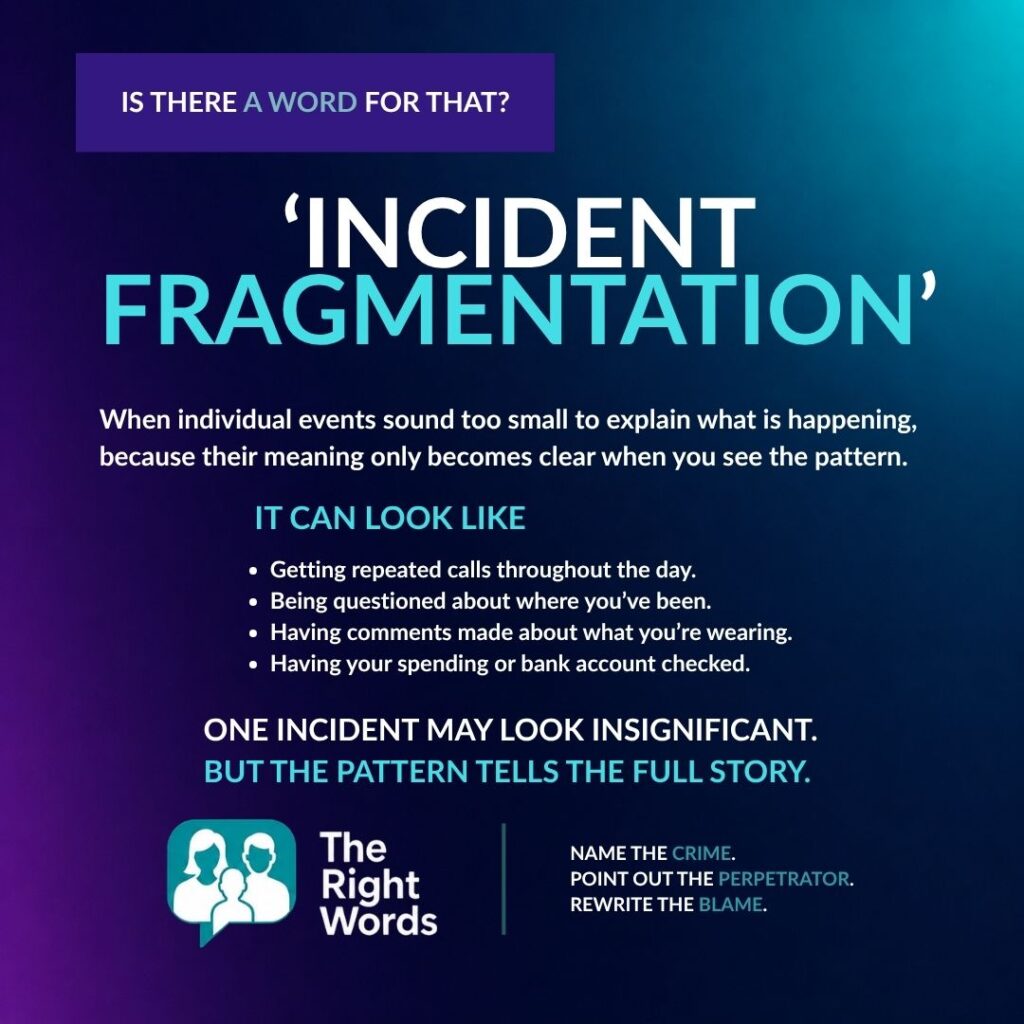
Incident Fragmentation
‘Incident fragmentation’ describes what happens when a pattern is broken down into individual events, making the whole experience harder to recognise and explain.
Read more +
Read less −
Incident Fragmentation
‘Incident fragmentation’ describes what happens when a pattern is broken down into individual events, making the whole experience harder to recognise and explain.
Read more + Read less −Sometimes, when it comes to abuse, what happened cannot be understood one incident at a time.
A repeated call, being questioned about where you’ve been, a comment about what you’re wearing, or someone checking your spending.
Taken separately, each can sound minor, be dismissed, explained away, ignored, or stripped of the context that gives it meaning. But put those incidents together, and a very different picture can emerge.
‘Incident fragmentation’ describes what happens when a pattern is broken down into individual events, making the whole experience harder to recognise and explain.
This matters when people try to tell others what they’re experiencing and it matters when institutions assess what has happened.
Sometimes, the question isn’t simply ‘What happened?’
It’s ‘What does everything that happened add up to?’
Name the crime. Point out the perpetrator. Rewrite the blame.

Anticipatory Compliance
When certain choices have repeatedly been followed by anger, punishment, withdrawal, humiliation, or another consequence, you can learn to change your behaviour before anything…
Read more +
Read less −
Anticipatory Compliance
When certain choices have repeatedly been followed by anger, punishment, withdrawal, humiliation, or another consequence, you can learn to change your behaviour before anything…
Read more + Read less −“But they never actually told you that you couldn’t.”
Often, they don’t have to.
When certain choices have repeatedly been followed by anger, punishment, withdrawal, humiliation, or another consequence, you can learn to change your behaviour before anything is said.
It has a name: anticipatory compliance.
From the outside, it can look like choice: YOU changed the plans, YOU stopped mentioning the friend, YOU chose what to wear, YOU decided not to raise the subject.
What that description misses is everything you had already learned about what happened when you chose differently.
This is why looking only for explicit rules can miss how coercive control actually operates. Sometimes the rule has been communicated so effectively through consequences that it no longer needs to be spoken.
Having a choice is not always the same as being free to make it.
Name the crime. Point out the perpetrator. Rewrite the blame.